Home
About
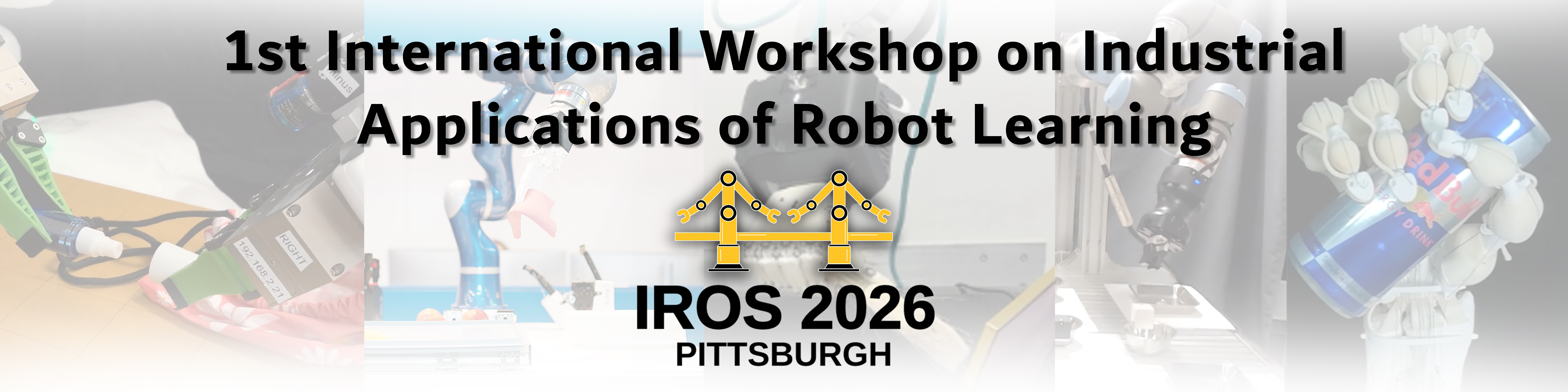
Robot Learning is ready to leave the lab and go into industry as proven by the recent wave of Embodied AI and Physical AI startups jointly attracting billions of dollars in investment. Over the past decade, advances in deep reinforcement learning, imitation learning, large-scale simulation, and foundation models have enabled robots to learn tasks from data and operate in less structured environments. Unlike traditional industrial robots that depend on rigid programming and controlled settings, these systems promise greater autonomy and adaptability for real-world deployment. In this workshop we will discuss the state-of-the-art in industrial applications of robot learning with speakers working on the frontlines both in industry and in academia. Motivated by the global importance of this transition, efforts are underway worldwide, including startup- and industry-driven projects in the US, large-scale programs across Europe, such as Robust and Trustworthy Generative AI for Robotics and Industrial Automation (RIA), and projects in Asia, including JST and NEDO initiatives in Japan supporting learning-based industrial robotics. As robot learning approaches real-world deployment, this workshop will foster discussion on a central question for industry: whether robot learning is ready to meet the high standards of precision, reliability, safety, and robustness in industrial applications, and how to bridge the remaining gaps to achieve them.
Topics of Interest include (but are not limited to):
- Industrial applications of robot learning
- Learning visual, force, tactile, and audio perception
- Learning dexterous manipulation
- Learning-based manipulation and long-horizon task execution
- Sim-to-real transfer and data-efficient learning
- Foundation models and generative AI for industrial robots
- Human-robot collaboration and adaptive shared autonomy
- Benchmarking and evaluation of precision, reliability, and performance
- Safety, trustworthiness, and robustness in learning-enabled industrial robots
Speakers and Panelists


Amazon Robotics



Mimic Robotics

Amazon Robotics




Samsung Research America
Important Information
Best Student Paper ($1000),
Best Poster Presentation ($500)
Submission guidelines
Submissions should be 2-8 pages (including references), following the IROS format. Accepted papers will be presented at the workshop as posters. Research award candidates will give 8-minute talks. All submissions will undergo a single-blind peer review process (via open review).
Organizers


American University Kyiv

RIKEN



Award Winners
Best Paper Award
PREFAIL: Identifying Precursors to Failures in Robotic Lift-and-Place Tasks to Improve Task Execution Performance
PDFBest Student Paper Award
Self-Supervised Multisensory Pretraining for Contact-Rich Robot Reinforcement Learning
IEEE XploreBest Poster Award
HiveBoard: An Open, Modular, 3D-Printed Benchmark of Industrial Mechanisms for Robotic and Prosthetic Manipulation
PDFBest Poster Award
MultiGraspNet: A Multi-task 3D Vision Model for Multi-gripper Robotic Grasping
arXivSupported by